.png)
Medieval Fairs and the Rise of Trade Culture Across Europe
Updated: Jul 27
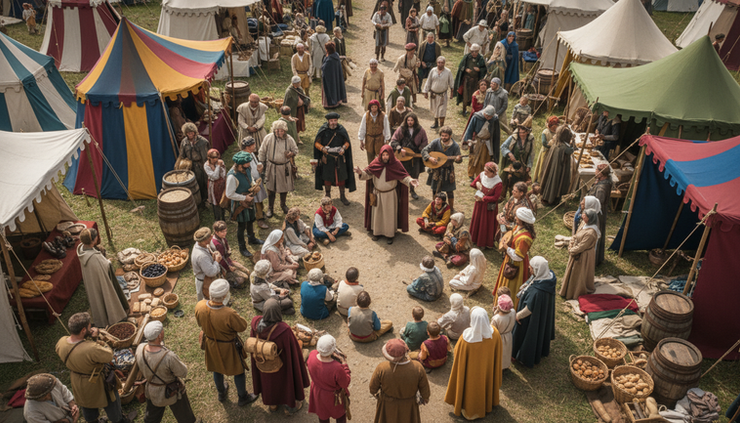
A medieval fair could turn a quiet town into the center of a continental trade network for a few crowded weeks. Roads filled with packhorses, riverboats carried barrels and cloth, and merchants arrived with coins, contracts, samples, and guarded hopes. These fairs did more than sell goods. They helped Europe build habits of credit, law, measurement, and long-distance exchange that shaped local economies for centuries.

Fairs grew from local markets into international meeting points
Early medieval trade often centered on weekly markets, monasteries, ports, and royal towns. By the 11th and 12th centuries, population growth, expanding agriculture, and safer roads helped create bigger events. A fair usually ran for several days or weeks and often took place on a saint’s feast day, when religious observance and trade drew crowds at the same time.
The fair’s timing mattered. Lords, bishops, and kings granted charters that protected merchants and set rules for tolls, booths, weights, and disputes. These privileges made travel less risky and gave traders a reason to return year after year. A fair could bring in rent from stalls, fees from bridges and gates, and taxes on sales. For local people, it meant work as porters, translators, innkeepers, guards, cooks, animal handlers, and craftspeople.
The famous Champagne fairs in northeastern France show how far this system could reach. Set between northern Europe and the Mediterranean world, the towns of Lagny, Provins, Troyes, and Bar-sur-Aube hosted a cycle of fairs that linked Flemish cloth makers, Italian bankers, French wine sellers, and merchants from many other regions. These fairs became reliable meeting points in an age when travel was slow and dangerous.
Goods at the fair revealed the shape of medieval life
A medieval fair was part warehouse, part shopfront, part social gathering. Some goods served daily needs, while others signaled wealth and status. The range depended on the region, but several categories appeared again and again:
Textiles
Wool cloth from Flanders, linen, silk, dyed fabrics, and raw wool
Food and drink
Salt, wine, grain, cheese, fish, honey, spices, and dried fruit
Luxury goods
Pepper, saffron, silk, glassware, fine metalwork, and jewels
Tools and household items
Knives, pots, leather goods, rope, needles, saddles, and farm equipment
Books and devotional objects
Manuscripts, parchment, wax tablets, pilgrim badges, and small religious images
Spices often attract the most attention in modern retellings, but cloth was one of the great commercial engines of the period. Wool moved from sheep farms to fullers, dyers, weavers, and merchants. A single bolt of high-quality cloth represented land, labor, skill, transport, and credit.

Merchants brought law, credit, and trust with them
The merchant at a fair was not only a seller. Merchants judged quality, arranged transport, borrowed and lent money, hired guards, hired scribes, and negotiated across languages. They also depended on reputation. A trader who cheated on weights or failed to honor a debt could lose access to future fairs.
Fair courts played a key role. They settled disputes quickly because merchants could not wait months for a case to move through ordinary courts. These courts handled broken contracts, unpaid debts, damaged goods, and quarrels over measurements. Their speed helped trade keep moving.
Credit also became more refined at major fairs. Rather than move heavy coins across long distances, merchants used written promises, partnerships, and account books. Italian merchants were especially skilled in these methods. At the Champagne fairs, debts could be recorded, transferred, and settled at later fairs in the cycle. This did not create modern banking by itself, but it helped strengthen the habits that made more complex finance possible.
The fairground had its own rhythm. Inspectors checked weights. Money changers compared coins from different regions. Scribes wrote contracts. Guards watched gates and roads. Innkeepers knew regular customers by name. A successful fair depended on these support roles as much as on the people selling wool, wine, or saffron.

Notable fairs carried regional character
Different regions developed distinct fair traditions. The Stourbridge Fair near Cambridge became one of England’s best-known fairs. It grew especially important in the later Middle Ages and early modern period, drawing traders who sold cloth, horses, books, food, and household goods. Its scale made it a useful barometer of English trade over time.
In the German-speaking lands, Frankfurt and Leipzig became major commercial centers. Their fairs linked east and west, especially as trade expanded along river routes and overland roads. Leipzig later became strongly associated with book trading, showing how fairs could specialize as economic life changed.
In Flanders, towns such as Bruges connected northern cloth production with wider European trade. Bruges was not simply a fair town in the same model as Champagne, but it shared the fair culture of meeting, exchange, credit, and negotiation. Italian, German, English, and Iberian merchants gathered there, turning the city into a powerful commercial hub.
Farther south, fairs in areas such as Champagne, Lombardy, and Catalonia connected local produce with Mediterranean goods. A merchant might bring wool cloth north and return with dyestuffs, spices, or fine metalwork. Each fair reflected geography: river access, nearby farms, political protection, and links to ports all shaped what people bought and sold.
Fairs spread stories as well as goods
Trade carried more than objects. Medieval fairs moved songs, fashions, recipes, craft techniques, legal habits, religious items, and news. A fairgoer might hear about a distant war, a saint’s shrine, a new coinage, or a disease outbreak before such news reached the countryside through official channels.
Language barriers made fairgrounds lively places of translation and gesture. Merchants learned key words in several tongues, and brokers often helped strangers do business. Cultural exchange could be practical. A dyer might study a foreign cloth. A metalworker might copy a tool. A cook might experiment with imported spices after seeing how wealthy buyers used them.
Anecdotes from fair culture often stress both opportunity and risk. Merchants traveled in groups for safety. Some carried letters of protection from rulers. Others marked goods with seals to prove origin and quality. A chest of coins or a pack of silk could attract thieves, but a successful trip could transform a family’s fortunes.
The lasting importance of medieval fairs
Medieval fairs helped local economies grow by concentrating demand, labor, money, and information in one place. They gave farmers access to wider markets, helped towns collect fees and rents, and allowed craftspeople to reach buyers beyond their neighborhood. They also trained Europe in the routines of long-distance commerce: contracts, credit, fair courts, standard weights, and trust across borders.
Their influence did not end when permanent shops, banks, and exchanges became more common. Many later commercial habits grew from patterns tested at fairs. The fairground showed that trade needed more than eager buyers and rare goods. It needed roads, rules, records, protection, and shared expectations.
The best way to understand medieval fairs is to see them as engines of connection. In one field or town square, local life met the wider world, and Europe learned how commerce could bind distant regions together.


Comments