.png)
How the Industrial Revolution Transformed Marketing and Distribution
Before the Industrial Revolution, most goods moved slowly, sold locally, and arrived in small batches. A customer might know the person who made a pair of shoes, a length of cloth, or a farm tool. Prices, quality, and availability changed from town to town. Marketing was often personal, and distribution depended on roads, rivers, animals, and weather.
Industrialization changed that system at every level. Machines increased output. Steam power changed where goods could be made. Railroads and canals changed how far they could travel. Printing, packaging, and retail innovation changed how people learned about products and made buying decisions.
The result was not simply more goods. It was a new commercial order: mass production required mass distribution, and mass distribution required more deliberate marketing.
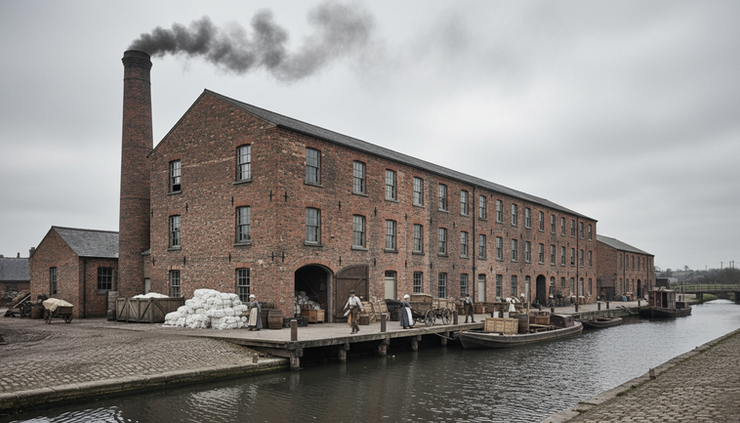
Production scale changed the purpose of marketing
In preindustrial markets, many producers made goods to order or in limited runs. A weaver, blacksmith, or carpenter served a known community. Reputation mattered, but promotion stayed narrow because output stayed narrow.
Factories changed the basic problem. Once machines could produce textiles, metal goods, ceramics, soap, processed foods, and other items in larger quantities, producers needed buyers beyond the immediate area. The question shifted from “Who nearby needs this?” to “How do we create demand across a wider market?”
That shift gave marketing a broader role. It became a way to:
Explain unfamiliar manufactured goods
Build trust at a distance
Make products recognizable across regions
Encourage repeat purchases
Support faster sales cycles
The Industrial Revolution did not create persuasion from nothing. Traders, printers, and shopkeepers had promoted goods long before factories. What changed was the pressure to do it consistently and at scale.
Standardization made products easier to sell
Mass production encouraged standard sizes, grades, and specifications. That mattered for marketing because standard goods were easier to describe and compare.
A bolt of machine-made cloth could be sold by consistent measure and type. A tool made with interchangeable parts could promise repairability and reliability. Packaged goods could carry the same name, weight, and appearance from one store to the next.
This reduced uncertainty. Customers did not have to inspect every item as if it were unique. Retailers could order stock with more confidence. Wholesalers could move goods through larger networks. Marketing became less dependent on face-to-face trust and more dependent on recognizable product identity.
Lower production costs expanded the customer base
Mechanization often reduced the cost of certain goods over time, especially textiles. Items that had once been expensive became more attainable for working and middle-class households.
That widened the market. Producers no longer sold only to elites or local buyers. They could aim for volume. Marketing followed this change by speaking to broader needs: durability, convenience, cleanliness, fashion, and value.
The rise of a larger consumer culture did not happen overnight, and it varied by country, class, and product. Still, industrial production made it possible for more people to buy more kinds of goods more often.
Transportation turned local markets into regional and national markets
Production alone could not transform commerce. Factories needed raw materials coming in and finished goods going out. The great distribution breakthrough came from improved transportation.
Canals, turnpikes, steamships, and railroads lowered costs and reduced travel time. They also made delivery more predictable. That predictability changed how businesses planned, priced, and sold.

Railroads made distance less restrictive
Railroads linked factories, ports, farms, mining areas, and cities. They moved goods faster than horse-drawn transport and with greater capacity. For manufacturers, this opened access to new customers. For retailers, it made inventory more dependable.
A store no longer had to rely only on local makers or irregular shipments. It could stock manufactured goods from distant industrial centers. A factory no longer had to wait for a nearby market to absorb its output. It could serve towns and cities along expanding rail lines.
This changed business strategy. Distribution routes became part of competitive advantage. Firms that could move goods reliably had better chances of reaching customers before rivals did.
Ports and steamships expanded international trade
Steamships also reshaped distribution. They made ocean transport more reliable than sail alone, especially as steam technology improved. Industrial economies imported raw materials and exported finished goods through ports that became major commercial hubs.
Cotton, coal, iron, grain, wool, tea, sugar, and manufactured goods moved through increasingly connected trade routes. This did not create a fair or equal global system. Industrial expansion was closely tied to empire, labor exploitation, and unequal access to resources. Still, from a marketing and distribution standpoint, it expanded the scale at which firms imagined their markets.
Products could be made in one region, packaged in another, shipped across an ocean, and sold through urban retailers or local merchants. The modern supply chain began to take shape.
Communication advances made commerce faster
Distribution depends on information as much as movement. A merchant needs to know what customers want. A manufacturer needs to know what inventory exists. A wholesaler needs to coordinate orders, shipments, and payments.
The telegraph changed commercial communication in the 19th century by allowing messages to move far faster than physical mail. Businesses could confirm prices, place orders, check supply, and respond to market changes with new speed.
This mattered for marketing too. Faster communication helped firms coordinate campaigns, manage sales territories, and respond to demand across distant markets. Newspapers also carried commercial information across wider audiences, while improved printing made catalogs, circulars, posters, and product notices easier to produce in larger numbers.
Print connected sellers with strangers
Industrial printing did more than produce books and newspapers. It gave businesses tools to reach people they would never meet.
Printed materials helped sellers present products in a consistent way. They could list features, prices, sizes, uses, and ordering instructions. This supported a major shift in buyer behavior: people could consider goods before entering a shop, or even buy without visiting one.
By the late 19th century, mail-order catalogs became especially important in the United States. Companies such as Montgomery Ward and Sears, Roebuck and Co. used catalogs to reach rural customers who had limited access to urban stores. These catalogs were both marketing tools and distribution systems. They displayed products, built trust, invited orders, and connected buyers to rail and postal networks.
That model showed a key lesson of industrial commerce: the message and the delivery system had to work together.
Retail changed as cities grew
Industrialization drew many people into cities and industrial towns. Urban populations created dense markets where retailers could sell more goods to more people in one place.
This encouraged new retail formats. Shops grew larger. Window displays became more important. Fixed prices became more common in many settings, reducing the need for constant bargaining. Department stores emerged in major cities, offering wide ranges of goods under one roof.

Department stores made shopping an experience
Department stores changed marketing by making retail itself a form of attraction. They organized goods by category, used displays to spark interest, and encouraged browsing. They also helped normalize seasonal buying, household purchasing, and fashion cycles.
This was a major step away from purely need-based shopping. The store became a place where customers could compare, discover, and desire. Marketing became physical, visual, and spatial.
For manufacturers, department stores offered access to many customers. For retailers, manufactured goods offered variety and novelty. The two systems supported each other.
Packaging changed trust and recognition
Packaging became more important as goods traveled farther from their makers. A package protected the product, but it also served as a communication tool. It could show contents, quantity, origin, and instructions. Over time, packaging helped customers recognize the same product across different stores.
This was especially important for food, medicine, soap, tobacco, and household goods. Instead of buying anonymous bulk items, customers increasingly bought named, packaged products. That change helped create modern brand loyalty, even if the word “brand” had older roots.
Packaging also changed distribution. Goods that could be packed, stacked, stored, and shipped efficiently moved more easily through wholesalers, warehouses, railcars, and stores.
Wholesalers and middlemen became essential links
As markets expanded, producers could not always sell directly to every shop or customer. Wholesalers, brokers, agents, and jobbers filled the gap. They bought in quantity, stored goods, extended credit, and supplied retailers across territories.
These intermediaries gave manufacturers reach. They also gave retailers access to stock without dealing with dozens of producers one by one. In many industries, the middle layers of distribution became as important as the factories themselves.
The system had trade-offs. Each layer added costs and influenced what customers could buy. Wholesalers often had power over which products reached shelves. Still, they solved a central problem of industrial commerce: matching high-volume production with scattered demand.
Before industrialization | After industrialization |
Goods were often made locally or by hand | Goods were increasingly made in factories |
Sellers relied heavily on personal reputation | Sellers used print, packaging, and wider recognition |
Transport was slower and less predictable | Railroads, canals, and steamships improved reach |
Markets were mostly local or regional | Markets became regional, national, and international |
Products varied more from maker to maker | Standardization made comparison and repeat buying easier |
Marketing became more organized
As production and distribution grew more complex, marketing became less accidental. Businesses needed repeatable methods for attracting customers and supporting sales networks.
This led to more systematic use of newspapers, catalogs, trade cards, signage, displays, and later national campaigns. Some companies began to think carefully about product names, package design, claims, retail placement, and customer confidence.
Marketing also adapted to the realities of industrial society. Urban workers had different schedules and incomes than rural households. Middle-class consumers had growing interest in household comfort, cleanliness, clothing, and leisure goods. Rural customers needed access and reliability. Businesses used different channels to reach each group.
The rise of the national market
In the United States, the growth of railroads after the Civil War helped connect regional economies into a larger national market. Manufactured goods, agricultural products, raw materials, and mail-order purchases moved across long distances with increasing regularity.
This changed expectations. Customers began to see similar products in different places. Retailers could stock goods from manufacturers hundreds of miles away. Producers could plan for larger territories.
National markets also created stronger competition. Local producers now faced goods made elsewhere, often at lower cost. Marketing became a defense as well as a growth tool. A company had to explain why its product deserved attention in a crowded field.

The transformation came with social costs
The commercial gains of industrialization came with serious human and social costs. Factory labor could be dangerous and exhausting. Child labor, long hours, crowded housing, pollution, and low wages marked many industrial communities. Distribution networks also depended on hard physical labor in ports, rail yards, warehouses, and mines.
Marketing and distribution did not develop apart from these conditions. Cheap goods often reflected cheap labor. Fast delivery depended on workers who loaded, hauled, sorted, and sold products under difficult circumstances.
A fair account of industrial marketing must include this reality. Industrialization helped create modern consumer markets, but it also raised questions about labor rights, public health, regulation, and corporate responsibility. Many of those questions remain part of commerce today.
Why this history still matters
Modern marketing and distribution look very different from their 19th-century forms, yet many core principles come from the industrial era.
Businesses still need to match production with demand. They still depend on reliable logistics. They still use packaging, product identity, retail placement, and customer trust to compete. They still face the challenge of selling to people they may never meet.
The channels have changed. Rail catalogs gave way to e-commerce pages. Telegraph messages gave way to real-time inventory systems. Department store displays now exist alongside search results and online marketplaces. Yet the underlying pattern remains familiar: when production capacity grows, marketing and distribution must evolve with it.
The Industrial Revolution transformed marketing and distribution by turning commerce into a coordinated system. Factories produced more goods, transportation carried them farther, communication moved information faster, and retailers found new ways to create demand. The modern marketplace began when these pieces started working together.
The lasting takeaway is clear. Marketing is never just promotion, and distribution is never just delivery. Each shapes the other. Industrialization proved that a product’s success depends not only on how it is made, but also on how it is explained, trusted, moved, displayed, and made available to the people who need it.


Comments